
Robot welding is the use of mechanized programmable tools (robots), which completely automate a welding process by both performing the weld and handling the part.
Processes like gas metal arc welding, while often automated, are not necessarily equivalent to robot welding, since a human operator sometimes prepares the materials to be welded.
The process is ideal for situations where a large number of welds are repeated and that need to be performed quickly. The robots are utilized in controlled environments such as an automotive assembly plant. Robots are continually monitored by human welding professionals to verify weld integrity and to adjust the equipment as necessary.
The auto industry has been using Mig robots for over 35 years, utilizing over 100,000 robots.
The cost of each robotic cell is approximately $60K to $75K (U.S. Dollars) for low-end systems.
Mid-range systems cost $75K – $150K while high-end systems cost $150K or more.
As a rule of thumb, a work cell will cost 3x to 10x the price of the robot.
Robotic Welding and Cutting Examples Video Demonstration

Overview
Types of Robots
Robot welding is commonly used for resistance spot welding and arc welding in high production applications, such as the automotive industry.
Robot welding is a relatively new application of robotics, even though robots were first introduced in United States industry during the 1960s.
The use of robots in welding did not take off until the 1980s, when the automotive industry began using robots extensively for spot welding.
Since then, both the number of robots used in industry and the number of their applications has grown greatly.
Cary and Helzer suggest that, as of 2005, over 120,000 robots are used in North American industry, with about half of them pertaining to welding.
Growth in robotic welding is primarily limited by the high equipment cost, and the resulting necessity of using it only in high production applications.
Robot arc welding has begun growing quickly and commands about 20% of industrial robot applications.
Robot Manufacturers
Leading robotic welding manufacturers include:
- Lincoln Electric
- ABB
- Adept
- Seiko
- Kawasaki
Costs for a robotic welding cell start at $50,000 (US Dollars). A robot without the welding equipment can cost as low as $20K.
History of Robotic Welding
Robotic Welding Assembly Line
The first works on robotics may be traced back until 270 BC, in ancient Greece, to the water clocks with mobile figures designed by the Civil Engineer Ctesibius.
His work was followed by Phylo of Byzantium (author of the book “Mechanical Collection”, 200 BC), Hero of Alexandria (85 BC) and Marcus Vitruvius (25 BC).
Several hundred years later, the Arabians documented (the three Banu Musa working for the Kalifa of Baghdad, 786-833 AC) and developed
(Badías-Zaman Isma’Il bin ar-Razzaz al-Jazari in the book “The science of the Ingenious Devices”, 1150-1220 AC) the Greek designs to be used on their own creations.
Leonardo Da Vinci
Leonardo Da Vinci also spent some time on robotics, when he was working for the Sforza family. By the same time he painted “The last supper”, he was also involved with building the “Salle delle Asse” of the Sforza Castle, where he planned to put a human-like robot in the form of a XV century knight.
Somehow, the plans and drawings were never found, although some pages of his famous book “Codex Atlanticus” are missing precisely in the point where it seams that he was preparing the robot project.
Nicola Tesla
Nicola Tesla did another outstanding contribution to robotics, in the turn to our century. He was thinking about automation and how he could command them or “embody” intelligence on them. At the time, there was a German scientist (Hertz) claiming that an electromagnetic excitation generates radiation of the same type that can be detected far from the excitation. Tesla thought about using this to command an automaton: the term “teleautomatics” appeared. In its own words:
… But this element I could easily embody in it by conveying to it my own intelligence, my own understanding. So this invention was evolved, and so a new art came into existence, for which the name “teleautomatics” has been suggested, which means the art of controlling movements and operations of distant automatons.
Technical Milestones
- ’70: General Motors creates the first robot integrated body assembly line with 24 robots and an indexing conveyor system
- ’74: Electrical Drive Train
- ’74: Microprocessor Control
- ’82: Cartesian Interpolation
- ’82: Computer Communication
- ’82: Joy-stick
- ’82: Menu Programming
- ’84: Vision Guidance
- ’86: Digital Control Loops
- ’86: AC Drives
- ’90: Networking
- ’91: Digital Torque Control
- ’94: Full Dynamic Model
- ’94: Windows Interface
- ’94: Virtual Robot
- ’94: Fieldbus I/O
- ’96: Co-operating Robots
- ’98: Collision Detection
- ’98: Load Identification
- ’98: Fast Pick & Place
Future of Robot Welding Systems
Future improvements in robotic welding systems include between capacity (performance, lower error rates), improved usability (easier to use and program) and connectivity (more ways to connect robots).
- Lower prices
- Higher performance
- More sophisticated sensor controls
- Better on-line control from production control systems
- Better simulation and off-line programming tools
- Better remote services
- Improved quality
- Improvements in diagnostics
- Reduction of energy consumption
- Support for wider range of production processes
- Force control as a regular feature
- Evolution to lighter structures
- More sophisticated software
- More uniformity in programming languages
- Better motion and force control
- Lower noise levels
- Lower maintenance costs
- Ability to replace large robots with smaller units
Robotic Arc Welding
Robotic Arc Welding in Automotive Assembly Plant
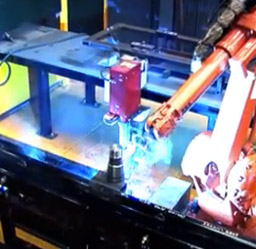
In general equipment for automatic arc welding is designed differently from that used for manual arc welding. Automatic arc welding normally involves high duty cycles, and the welding equipment must be able to operate under those conditions. In addition, the equipment components must have the necessary features and controls to interface with the main control system.
A special kind of electrical power is required to make an arc weld. The special power is provided by a welding machine, also known as a power source. All arc welding processes use an arc welding gun or torch to transmit welding current from a welding cable to the electrode. They also provide for shielding the weld area from the atmosphere.
The nozzle of the torch is close to the arc and will gradually pick up spatter. A torch cleaner (normally automatic) is often used in robot arc welding systems to remove the spatter. All of the continuous electrode wire arc processes require an electrode feeder to feed the consumable electrode wire into the arc.
Welding fixtures and workpiece manipulators hold and position parts to ensure precise welding by the robot. The productivity of the robot welding cell is accelerated by having an automatically rotating or switching fixture so that the operator can be fixing one set of parts while the robot is welding another.
To be able to guarantee that the electrode tip and the tool frame are accurately known with respect to each other, the calibration process of the TCP (Tool Center Point) is important. An automatic TCP calibration device facilitates this time-consuming task
Gas Selection
There are several factors that go into choosing the best gas to use for robotic welding systems including:
- base metal chemistry
- welding position
- base metal thickness
- base metal cleanliness
- type of metal transfer
- joint fit
Gas choices:
- Argon/CO2 (>82% argon)
- Argon/CO2/02 (>90% argon) which is preferred for gap bridging due to enhanced puddle fluidity
- Argon/Helium/CO2 (>70% argon, >25% Helium/Balance CO2) – preferred for nickel alloys and working with stainless steel
Robotic Spot Welding
Automatic welding imposes specific demands on resistance welding equipment. Often, equipment must be specially designed and welding procedures developed to meet robot welding requirements.
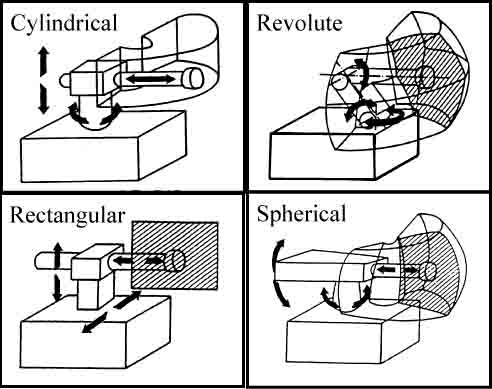
The most common type of robot used in spot welding is the six-axis revolute. Other types or spherical and rectangular.
Welding heat is generated by electrical resistance with no consumable electrodes, shielding gases or flux.
The spot welding robot is the most important component of a robotized spot-welding installation. Welding robots are available in various sizes, rated by payload capacity and reach. Robots are also classified by the number of axes. A spot welding gun applies appropriate pressure and current to the sheets to be welded. There are different types of welding guns, used for different applications, available. An automatic weld-timer initiates and times the duration of current.
During the resistance welding process the welding electrodes are exposed to severe heat and pressure. In time, these factors begin to deform (mushroom) the electrodes. To restore the shape of the electrodes, an automatic tip-dresser is used.
The surface must be clean and smooth to optimize bond strength and requires access to both sides of the joint.
Basics:
- Most common application for robotic welding
- Robots is programmed to follow a specific path
- Performs 30 welds/minute or more
Robotic spot welding systems consist of:
- spot welding package with robot and controller
- interchange units
- operator protection devices
- supporting frame
Components
The major components of arc welding robots are the manipulator or the mechanical unit and the controller, which acts as the robot’s “brain”.
The manipulator is what makes the robot move, and the design of these systems can be categorized into several common types, such as the SCARA robot and cartesian coordinate robot, which use different coordinate systems to direct the arms of the machine.
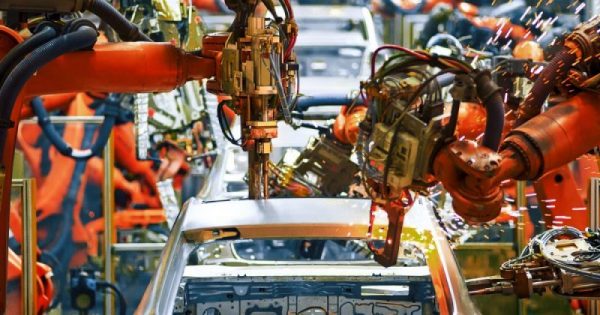
Industrial Robots Uses in Auto Production Welding
Applications
When should robots be used for welding?
A welding process that contains repetitive tasks on similar pieces might be suitable for automation. The number of items of any type to be welded determines whether automating a process or not.
If parts normally need adjustment to fit together correctly, or if joints to be welded are too wide or in different positions from piece to piece, automating the procedure will be difficult or impossible. Robots work well for repetitive tasks or similar pieces that involve welds in more than one axis or where access to the pieces is difficult.
Most production welding processes can be used in automated applications. The most popular, used in perhaps 80 percent of applications, is the solid wire GMAW process. This process is best for most high production situations because no post-weld cleanup is required.
The largest application is in automotive:
- operates 24 hours a day
- 2% downtime utilization of investment
- 75% to 100% reduction in man-hours
- improves control and output scheduling
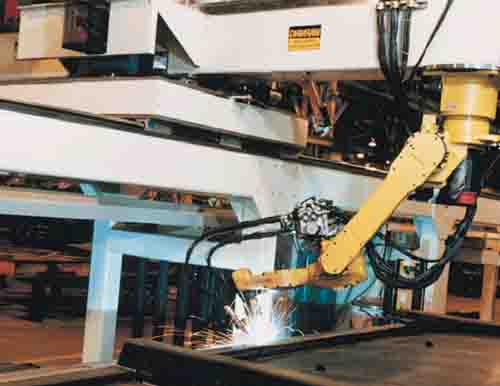
Robot on a Gantry for Welding Bigger Parts
Advantages
- improved quality
- reduced levels of over welding
- less post-weld cleanup
- increased operator productivity
- higher deposition rate, improved wire deposition efficiency
- faster torch travel speed
- improved weld appearance
- reduced operator skill
- reduced weld time, faster than humans
- lower total welding cost/foot
- lower rework
- consistent weld penetration
- improved flexibility with re-programming
- amortization of equipment costs over multiple shifts
- accident reduction
- can be used when in environments that are hazardous to humans
- fewer work stoppages
Why robotic welding? The most prominent advantages of automated welding are precision and productivity. Robot welding improves weld repeatability. Once programmed correctly, robots will give precisely the same welds every time on workpieces of the same dimensions and specifications.
Automating the torch motions decreases the error potential which means decreased scrap and rework. With robot welding you can also get an increased output. Not only does a robot work faster, the fact that a fully equipped and optimized robot cell can run for 24 hours a day, 365 days a year without breaks makes it more efficient than a manual weld cell.
Another benefit of automated welding is reduced labor costs. Robotic welding also reduces risk by moving the human welder/operator away from hazardous fumes and molten metal close to the welding arc.
Limitations
One problem when welding with robots is that the cables and hoses used for current and air etc. tend to limit the capacity of movement of the robot wrist.
A solution to this problem is the swivel, which permits passage of compressed air, cooling water, electric current and signals within a single rotating unit.
The swivel unit also enables off-line programming as all cables and hoses can be routed along defined paths of the robot arm.
Other limitations of robotic welding:
- Complex end-user programing, not user friendly, only for specialists
- Limited APIs, making a simple change complicated
- The human machine interface (HMI) not really working. Systems require customization and training. Difficult to customize robotic welding systems.
- Connectivity challenges, lack of inter-connectable standards
- Replaces human labor
- Technology becomes out of date
Robotic Welding System Cost Justification
There are many reasons why a robotic welding system may make sense for your organization. These include:
- shortage of trained welders
- technological advances allow for rapid part changeovers and interchangeable tooling nests or fixtures allowing for the welding of smaller batches
- decreased manufacturing cost
- improvement in quality
- favorable costs when compared to the fully burdened cost of labor (labor rate, building taxes, utilities, transportation)
- increased productivity
- reliability
- increase in volume produced
- minimize variability in welding
- savings in filler metal (reduces over welding)
- lower training costs
- more accountability due to arc data monitoring software
Success Tips
Follow these tips in order to improve your chance of success (and yield) from the robotic welding system investment:
- Optimize the system which includes programming support, filler-metal and shielding-gas selection.
- Pay attention to tooling design and be prepared to invest at least as much as you did for the robot.
- Weld in the flat or horizontal position when possible.
- Consider bulk wire and gas supply to maximize cell up-time.
- Give careful consideration to who will operate the system as the investment can be maximized with a fully trained operator with welding skill.
- Work on dimensional control of the parts being welded. A laser or precision plasma-cut part can be welded more economically as the part fit-up is consistent.
Training and Certification
AWS D16.4 sets the specification for qualification of Robotic Arc Welding personnel. It describes four levels of qualification:
- Level one to be handled by employer and not to be
construed as official AWS recognition - Level two and three have been combined into one
certification for the operator - Level four is the certification for the technician
Testing will determine if candidates for technician or operator meet the D16.4 performance and demonstration requirements. The passing rate is 75%. Applicants who fail to pass can re-apply to take the failed part of the test 30 days after receiving the results from the AWS.
There is no limit to the number of times the test can be taken, however each applicant is limited to 3 times per year. The written and performance test must be passed within a 3 month period.
This includes a:
- Timed Performance Test
- Covers the practical demonstration of knowledge and ability involving a robotic system
- Consists of a series of tasks including a GMA welding test plate made to a WPS (welding procedure specification)
- Performance test must be completed and passed three months prior to or after taking the written test.
- The test can be administered at work, a training facility or school by a CRAW-T certified test supervisor.
- Must be able to identify all equipment used, as well as safety devices and issues (cannot lose more than 10 points to pass)
- Robot programming of test piece (20% of grade)
- Must perform gun, wire feed and shielding gas maintenance (40% of grade)
- Weld quality assessment (40% of grade)
- Must correct for part shifting
- Demonstrate ability to follow a welding procedure specification (WPS) and shop drawing. Weld will be judged for size, location, appearance and adherence to the WPS
- Written Closed Book Examination (2 hour timed exam)
- Applications for certification as CRAW operator or tech must get a grade of 75% or higher
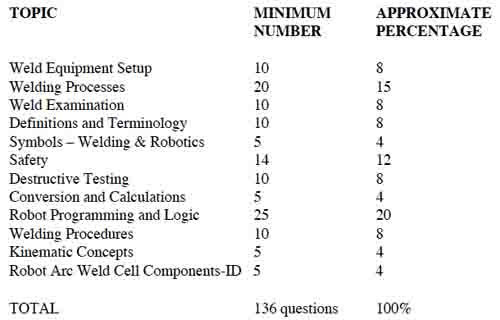
- General knowledge test consisting of 140 multiple choice questions
- Written examination is the same for both operator and technician
The technician level certification also allows this person to administer the practical demonstration part of the certification test
Topics Covered in Written Exam
Operator Certification
Position Definition: Operator. In the context of an AWS Certified Robotic Arc Welding- Operator it is a person capable of dealing with all aspects of an arc welding robot cell. These aspects are as detailed in the D 16.4
qualifications for a level 2 and 3 person.”
Experience and Educational Requirements for Operator Certification:
- Have a minimum of 4000 hours of welding experience
- Have a good mechanical aptitude
- Have a one year diploma in welding or robotic instruction
- Have good written and oral communication skills
Training Recommendations:
- Completion of original equipment manufacturer or equivalent
Robotic Programming course - Understand the use of the teach pendant
- Have instruction in the proper operation of cross sectioning related tools and hardware such as plasma cutting and band saws
- Have instruction in the applicable destructive testing methods,
such as macrotech test or bend test - Have continuing education in robotic arc welding related
disciplines - Have basic instruction in workings of all of the robotic peripheral
equipment - Have basic instruction covering the safe and proper operation of
the robot mechanical arm and control circuitry - Visual inspection course for the applicable product
Technician Certification
Experience and educational requirements:
- Meet all of the level 1, 2, and 3 requirements
- Have minimum 5 years welding experience with all relevant processes
- Have a two year Associates Degree in Welding/Robotics/Electrical or equivalent
- Hold current AWS CWI certification (Certified Welding Inspector).
Training Recommendations:
- Meet levels 1, 2, and 3 with the addition of:
- Receive instruction in the operation of quality measuring tools including applicable computer software for measuring the weld cross section
- Be familiar with personal computers