
Good welding safety is 99% proactive and 1% reactive!
Welding causes solid metal to vaporize, as it cools, it condenses forming solid particles which take the shape of a fume.
Cutting or welding rusty steels or any other materials listed on this page can increase risks of injury due to the high pressure and volume of air mixed with smoke during the operation.
Fumes are small particles (smaller than dust). Unless fumes are removed, they can stay suspended in air indefinitely.
Direct Draw or forced ventilation should be used AND Personal Protective Equipment should be used with these materials as well. In addition, bystanders should be protected as well. (always check MSDS safety data sheets for materials being used)
If these conditions arise the safest precaution is to contact your physician immediately.
It is important you inform the physician about the situation as this condition is not common outside of the construction/fabrication field.
There is nothing wrong with coming right out and saying “I think I contacted metal fume fever from cutting on ——- from 2:00 to 3:30 yesterday”.
There are various types of welding ventilation systems that can be used but the number one rule of ventilation is the placement of your head in relationship to the fumes and smoke produced!
Approved respirators may be required when ventilation is not adequate.
Welding fumes can cause harmful conditions such as:
- Welding tract irritation
- metal fume fever
- Siderosis: chronic inflammation of the lungs
- Increased risk of lung cancer
Welding Fume Respirators:
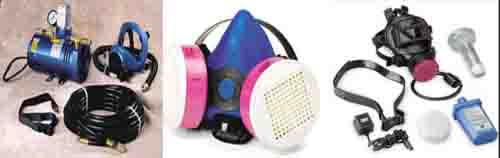
Fume Composition
The composition of welding fumes depends on the metal being welded, the process, electrode type and rod.
Check the MSDS from the manufacturer. Fumes can be comprised of oxides or metals.
Fume Exposure Factors
There are several factors that should be taken into account when considering worker exposure to fumes:
- Ventilation controls
- Air movement
- Welder work practices
- Location (outside, enclosed spaces)
- Welding rod composition
- Filler and base metals used
- Welding process
Fume Toxicity
Toxicity is referred to as being acute or chronic. Toxicity usually involves more than one metal and toxic effects may be additive.
Acute Toxicity (occurs suddenly):
- Symptoms that appear right after exposure
- Exposure to high concentrations of fume particles in a short period of time.
Chronic Fume Toxicity:
- Exposure to fumes over long time periods such as months and years
- Symptoms start to appear a long time after the first exposure
Fume Sampling
Welding Fume Sampling Methods
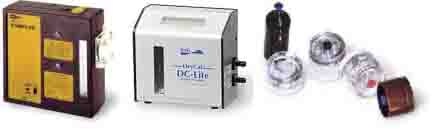
Depending on the regulation, fumes are measured/sampled using filters, a pump calibrator or a sample pump.
They are placed in the zone where the welder would be breathing, under the hood.
A pump draws air over the filter with the filter capturing any contaminants.
The filter is sent to a lab for analysis.
Ventilation for General Welding and Cutting
Local Exhaust Ventilation
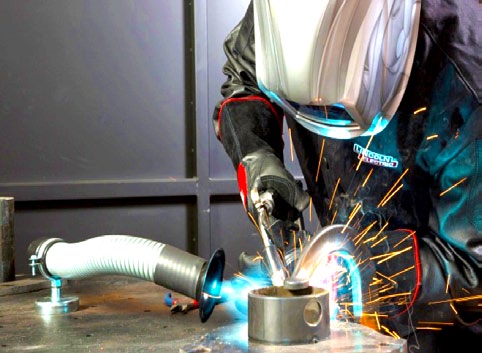
Mechanical ventilation is the movement of air through a workplace by a mechanical device such as a fan. It is reliable and better than natural ventilation. Types include:
- Local exhaust
- Local forced air
- General ventilation
Mechanical ventilation is always best but is essential in;
- A space of less than 10,000 cu ft (284 cu m) per welder.
- A room having a ceiling height of less than 16 ft (5 m).
- Confined spaces
- wWhere the welding space contains partitions or other barriers that obstruct ventilation.
Local exhaust ventilation systems include a capture device, ducting and a fan. Types include:
- Vacuum nozzle at the arc
- Fume hoods
- Gun mounted fume extractor
Local forced air ventilation uses a fan that moves air horizontally across a welder’s face.
More recent advancements use PAPR helmet systems that are connected to the welding to supply continuous fresh air into the helmet.
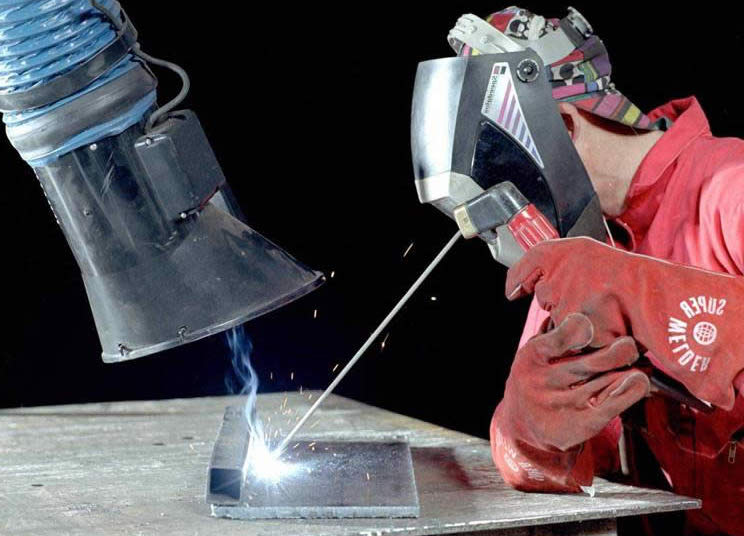
Fixed Duct System and Capture Hood
Minimum Rate
Ventilation shall be at the minimum rate of 200 cu ft per minute (57 cu m)
Hoods
Freely movable hoods or ducts are intended to be placed by the welder as near as practicable to the work being welded.
These will provide a rate of airflow sufficient to maintain a velocity in the direction of the hood of 100 in linear feet per minute in the zone of welding.
Local Exhaust Ventilation – Portable Welding Fume Eliminator
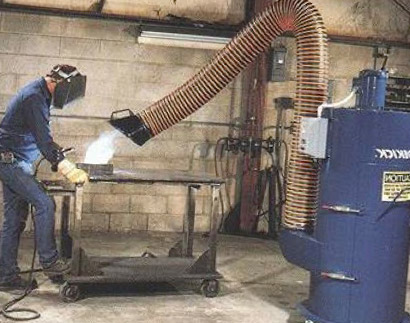
Fixed Enclosure
Ventilation in Confined Spaces
- Air replacement: Ventilation is a prerequisite to work in confined spaces. All welding and cutting operations in confined spaces shall be adequately ventilated to prevent the accumulation of toxic materials -or possible oxygen deficiency. This applies not only to the welder but also to helpers and other personnel in the immediate vicinity.
- Airline respirators: In circumstances where it is impossible to provide adequate ventilation in a confined area, airline respirators or hose masks, approved by the US Bureau of Mines, National Institute of Occupational Safety and Health, or other government-approved testing agency, will be used for this purpose. The air should meet the standards established by Public Law 91-596, Occupational Safety and Health Act of 1970.
- Self-contained units: In areas immediately hazardous to life, hose masks with blowers or self-contained breathing equipment shall be used. The breathing equipment shall be approved by the US Bureau of Mines or National Institute of Occupational Safety and Health, or other government-approved testing agencies.
- Outside helper: Where welding operations are carried on in confined spaces and where welders and helpers are provided with hose masks, hose masks with blowers, or self-contained breathing equipment, a worker shall be stationed on the outside of such confined spaces to ensure the safety of those working within.
- Oxygen for ventilation: Oxygen must never be used for ventilation.
Metal Fume Fever
Symptoms
The symptoms of are nonspecific but are generally flu-like including:
- Fever
- chills
- nausea
- headache
- fatigue
- muscle aches
- joint pains
A sweet or metallic taste in the mouth that distorts the taste of food and cigarettes is also normally reported along with a dry or irritated throat which may lead to hoarseness.
Symptoms will normally disappear within 24 to 48 hours, and someone suffering from metal fume fever will usually feel well enough to return to work the next day despite the fact that they may still be feeling a little bit under the weather.
It often takes 4 days to fully recover. Symptoms can disappear over a long weekend of no exposure only to return when re-exposed.
Cause
The exact cause of metal fume fever is not known.
The most plausible theory involves an immune reaction that occurs when inhaled metal oxide fumes injure the cells lining the airways.
This is thought to modify proteins in the lung. The modified proteins are then absorbed into the bloodstream, where they act as allergens.
It is usually associated with inhaling zinc fumes, with some believing that copper and magnesium can also cause the problem.
Diagnosis
Physical examination findings vary among persons exposed, depending largely upon the stage in the course of the syndrome during which examination occurs.
Patients may present with wheezing or crackles in the lungs. They may also have an increased white blood cell count, and urine and blood plasma zinc levels may (unsurprisingly) be elevated.
Chest X-ray findings are generally unremarkable.
Diagnosis of metal fume fever can be difficult, as the complaints are nonspecific and resemble a number of other common illnesses.
When respiratory symptoms are prominent, metal fume fever may be confused with acute bronchitis.
The diagnosis is based primarily upon a history of exposure to metal oxide fumes.
An interesting feature of metal fume fever involves rapid adaptation to the development of the syndrome following repeated metal oxide exposure. Those exposed daily may be immune.
Workers with a history of recurrent metal fume fever often develop a tolerance to the fumes.
This tolerance, however, is transient, and only persists through the workweek.
After a weekend hiatus, the tolerance has usually disappeared.
This phenomenon of tolerance is what led to the name “Monday Fever”.
Treatment
Treatment of metal fume fever consists of bed rest and symptomatic therapy (e.g. aspirin for headaches) as indicated.
Prognosis
The symptoms of metal fume fever are usually self-limiting and dissipate rapidly upon removal from the source of metal fumes.
Depending on the metals involved, repeated exposure can lead to longer-term illnesses such as bronchitis, pneumonia, pulmonary edema, nasal cancer and even bone damage.
Prevention
Prevention of metal fume fever in workers who are at potential risk involves avoidance of direct contact with potentially toxic fumes, improved engineering controls (exhaust ventilation systems), personal protective equipment (respirators), and education of workers regarding the features of the syndrome itself and proactive measures which can be taken to prevent its development.
Welding Chemical Agents, Fumes and Potential Health Effects
Welding Fume Toxicity Summary Table
| Kidney | Nervous | Liver | GI | Lung | |
|---|---|---|---|---|---|
| Aluminum | x | x | |||
| Beryllium | x | ||||
| Cadmium | x | x | x | x | |
| Chromium | x | x | x | x | |
| Cobalt | x | x | x | ||
| Copper | x | x | |||
| Iron | x | x | x | x | |
| Lead | x | x | x | ||
| Manganese | x | x | |||
| Nickel | x | x | |||
| Zinc | x | x |
Aluminum
Aluminum fumes can cause the following disorders, symptoms and health effects:
- Dementia
- Amyotrophic lateral sclerosis: chronic progressive disease marked by the gradual degeneration of the enever cells in the central nervous system that controls voluntary muscle movement.
- Parkinsons dementia
- Alzheimers (not a clear link, speculation, more research needed)
Beryllium
Beryllium is sometimes used as a alloying element with copper and other base metals.
- Acute exposure to high concentrations of beryllium can result in chemical pneumonia.
Long-term exposure can result in:
- shortness of breath
- chronic cough
- significant weight loss, accompanied by fatigue and general weakness
- Berylliosis: a scarring of the lungs preventing exchange of oxygen and carbon dioxide
- Lung cancer
Cadmium
Cadmium is used frequently as a rust-preventive coating on steel and also as an alloying element. Acute exposures to high concentrations or cadmium fumes can produce:
- severe lung irritation
- pulmonary edema
- in some cases, death.
Long-term exposure to low levels of cadmium in air can result in:
- emphysema (a disease affecting the ability of the lung to absorb oxygen) and can damage the kidneys.
- chronic obstructive pulmonary disease
- released enzymes from damaged cells in lungs results in irreversible damage
Cadmium is classified by OSHA, NIOSH, and EPA as a potential human carcinogen.
Carbon Monoxide
Carbon monoxide is a gas usually formed by the incomplete combustion of various fuels. Welding and cutting may produce significant amounts of carbon monoxide. In addition, welding operations that use carbon dioxide as the inert gas shield may produce hazardous concentrations of carbon monoxide in poorly ventilated areas. This is caused by a “breakdown” of shielding gas. Carbon monoxide is odorless, colorless and tasteless and cannot be readily detected by the senses. Common symptoms of overexposure include pounding of the heart, a dull headache, flashes before the eyes, dizziness, ringing in the ears, and nausea.
Chlorinated Hydrocarbon Solvents
Various chlorinated hydrocarbons are used in degreasing or other cleaning operations. The vapors of these solvents are a concern in welding and cutting because the heat and ultraviolet radiation from the arc will decompose the vapors and form highly toxic and irritating phosgene gas. (See Phosgene.)
Cobalt
Cobalt fume exposure can result in:
- Asthma
- Cumulative lung changes
- Dermatitis
Copper
Copper welding fumes exposure can result in:
- Nose and throat irritation
- Eye irritation
- Metal fume fever
- Edema (acute lung damage)
- Upper respiratory tract irritation
Fluorides
Fluoride compounds are found in the coatings of several types of fluxes used in welding. Exposure to these fluxes may irritate the eyes, nose, and throat. Repeated exposure to high concentrations of fluorides in air over a long period may cause pulmonary edema (fluid in the lungs) and bone damage. Exposure to fluoride dusts and fumes has also produced skin rashes.
Iron Oxide
Iron is the principal alloying element in steel manufacture. During the welding process, iron oxide fumes arise from both the base metal and the electrode. The primary acute effect of this exposure is irritation of nasal passages, throat, and lungs.
Although long-term exposure to iron oxide fumes may result in iron pigmentation of the lungs, most authorities agree that these iron deposits in the lung are not dangerous.
Disease-associated with iron welding fume exposure include:
- siderosis (fibrosis of the lungs caused by iron oxide exposure)
- lung function problems
- diabetes melitus
Lead
The welding and cutting of lead-bearing alloys or metals whose surfaces have been painted with lead-based paint can generate lead oxide fumes.
Inhalation and ingestion of lead oxide fumes and other lead compounds will cause lead poisoning. Symptoms include:
- metallic taste in the mouth
- loss of appetite
- nausea
- abdominal cramps
- insomnia
In time, anemia and general weakness, chiefly in the muscles of the wrists, develop. Lead adversely affects the brain, central nervous system, circulatory system, reproductive system, kidneys, and muscles.
Other effects can include problems that affect the:
- skeletal systems
- reproductive systems
- gastrointestinal problems
- kidney problems
Peripheral neuropathy can also occur which is damage that interrupts communication between the brain and other parts of the body. Symptoms include problems with muscle movement, sensation in the extremities and pain.
Mercury
Mercury compounds are used to coat metals to prevent rust or inhibit foliage growth (marine paints).
Under the intense heat of the arc or gas flame, mercury vapors will be produced.
Exposure to these vapors may produce stomach pain, diarrhea, kidney damage, or respiratory failure.
Long-term exposure may produce tremors, emotional instability, and hearing damage.
Manganese
Exposure to fumes from manganese include:
- liver cirrhosis
- compulsive behavior such as singing, fighting and running
- irritability
- difficulty walking
- disturbance in speech
- manganisum (manganese encephelopathy, a condition that is similar to Parkinson’s)
Magnesium
Exposure to magnesium fumes can cause metal fume fever and related symptoms such as muscle ache, fever and chills.
Nickel
Exposure to nickel welding fumes can cause:
- Nickel carbonyl is toxic (formed when carbon monoxide and nickel fumes combine)
- Respiratory tract carcinogen – can cause nasal cancer and lungs
Phosgene
Phosgene is formed by the decomposition of chlorinated hydrocarbon solvents by ultraviolet radiation. It reacts with moisture in the lungs to produce hydrogen chloride, which in turn destroys lung tissue. For this reason, any use of chlorinated solvents should be well away from welding operations or any operation in which ultraviolet radiation or intense heat is generated.
Ozone
Ozone (O3) is produced by ultraviolet light from the welding arc. Ozone is produced in greater quantities by gas metal arc welding (GMAW or short-arc), gas tungsten arc welding (GTAW or heli-arc), and plasma arc cutting. Ozone is a highly active form of oxygen and can cause great irritation to all mucous membranes. Symptoms of ozone exposure include headache, chest pain, and dryness of the upper respiratory tract. Excessive exposure can cause fluid in the lungs (pulmonary edema). Both nitrogen dioxide and ozone are thought to have long-term effects on the lungs.
Nitrogen Oxides
The ultraviolet light of the arc can produce nitrogen oxides (NO, NO2), from the nitrogen (N) and oxygen (O2) in the air. Nitrogen oxides are produced by gas metal arc welding (GMAW or short-arc), gas tungsten arc welding (GTAW or heli-arc), and plasma arc cutting. Even greater quantities are formed if the shielding gas contains nitrogen. Nitrogen dioxide (NO2), one of the oxides formed, has the greatest health effect. This gas is irritating to the eyes, nose and throat but dangerous concentrations can be inhaled without any immediate discomfort. High concentrations can cause shortness of breath, chest pain, and fluid in the lungs (pulmonary edema).
Vanadium
Fumes from vanadium are a skin and eye irritant. Other problems include:
- kidney damage
- nervous depression
- tremors
- cardiac palpitation
- abdominal pain
- vomiting
- nausea
- gastrointestinal distress
Zinc
Zinc is used in large quantities in the manufacture of brass, galvanized metals, and various other alloys. Inhalation of zinc oxide fumes can occur when welding or cutting on zinc-coated metals. Exposure to these fumes is known to cause metal fume fever.
Symptoms of metal fume fever are very similar to those of common influenza. They include:
- Fever (rarely exceeding 102o F)
- Chills
- Nausea
- Dryness of the throat
- Cough
- Fatigue
- General weakness
- Aching of the head and body.
The victim may sweat profusely for a few hours, after which the body temperature begins to return to normal.
The symptoms of metal fume fever have rarely, if ever, lasted beyond 24 hours.
The subject can then appear to be more susceptible to the onset of this condition on Mondays or on weekdays following a holiday than they are on other days.