
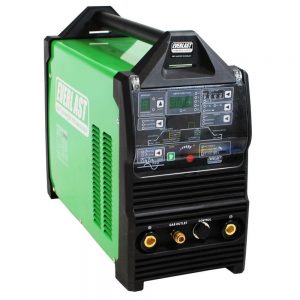
TIG Welding (GTAW) is a process that uses a non-consumable tungsten electrode to produce a weld with or without filler material.
The equipment is significantly different than MIG equipment and somewhat different than what is used for stick welding. That said, a welding machine with the right accessories can be fitted for TIG welding.
Basic TIG equipment components include:
- Tungsten electrode
- Welding machine (constant current-CC, AC, DC+, DC- or AC/DC). There are advantages to getting a machine that is designed for TIG welding in order to stay balanced during the weld (see below for explanation). Regardless of type, a high-frequency unit must be built-in or attached.
- Torch or electrode holder
- Shielding gas supply (helium, argon or mixture): argon better for thinner metals due to lower heat requirement
- Filler metal rod
- Personal safety equipment including TIG welding gloves
Most welding is done with DCSP or AC current. While the equipment is more expensive, there are many advantages to the TIG process.
One important disadvantage is that GTAW is less economical than consumable electrode processes for sections thicker than 3/8 of an inch.
Overview
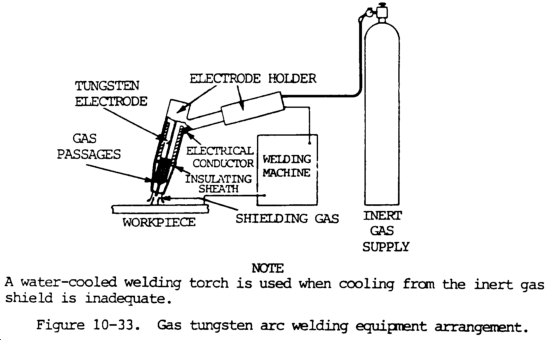
The basic features of the TIG equipment are shown in figure 10-33. The major components required for TIG welding are:
- The TIG welding machine (view recommended TIG welders here)
- The welding electrode holder and the tungsten electrode
- The shielding gas supply and controls
- Several optional accessories are available, which include a foot rheostat to control the current while welding, water circulating systems to cool the electrode holders, and arc timers.
Diagram of TIG Welding Equipment
There are ac and dc power units with built-in high-frequency generators designed specifically for TIG welding.
These automatically control gas and water flow when welding begins and ends.
If the electrode holder (torch) is water-cooled, a supply of cooling water is necessary.
Electrode holders are made so that electrodes and gas nozzles can readily be changed.
Mechanized TIG equipment may include devices for checking and adjusting the welding torch level, equipment for work handling, provisions for initiating the arc and controlling gas and water flow, and filler metal feed mechanisms.
GTAW Welding Machine
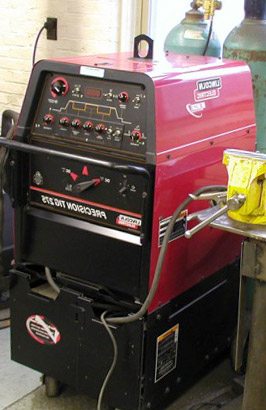
TIG Welding Machines
When welding using GTAW (TIG), the amount of heat energy created depends on arc polarity, arc voltage, and amperage. Polarity describes the direction of the current flow in DC welding.
There are two ways the welding current can flow, DCSP and DCRP.
DCSP Welding
Direct current flowing from the electrode (–) to the workpiece (+) is direct current straight polarity or DCSP. Most TIG welding is done with AC or DCSP current.
DCRP Welding
The current which flows from the workpiece (–) to the electrode (+) is direct current reverse polarity or DCRP.
Balance vs Unbalanced Welding
AC welding machines will either be unbalanced or balanced.
In AC machines, the current, in theory, flows in DCRP half of the time and DCSP half of the time.
When the current flows in the DCRP half of the cycle, the current is flowing from the workpiece to the electrode, causing a high resistance to current flow. This resistance, which is caused by the current that flows from the base metal (a large conductor), moves to a concentrated point in the tungsten electrode, which results in it heating up.
When in the DCSP half of the cycle, the current is flowing from the electrode tip, a small conductor, to the workpiece, a large conductor.
This direction of current flow has a cooling effect on the tungsten and enhances its current-carrying capacity.
The sinewave becomes “unbalance” when the AC machine doesn’t compensate for the higher resistance in the DCRP part of the cycle.
One-half of the time the voltage is higher than expected (DCSP), and one-half of the time the voltage is lower than expected (DCRP).
AC machines without the required circuitry to have sinewave balance should not have the amperage set at higher than 50% of rated capacity. If it is set higher, then the machine could be damaged.
The advantage of getting AC TIG equipment that has been designed for TIG welding is that the sinewave is balanced. When designed for TIG welding, there is a circuit built in that compensates for the part of the cycle that is DCRP, keeping the sinewaves equal or in balance.
HF (High Frequency) TIG welding units are Always Required
Whether AC or DC is used for TIG welding, a high frequency (HF) unit must be built into the machine, or a portable one must be attached to it.
The high-frequency unit produces high-frequency voltage (several thousand volts) at a frequency of several million cycles per second.
The current in the high-frequency circuit is only a fraction of an ampere.
Because of the high voltage and frequency, the current is carried on the surface of the conductor rather than penetrating throughout the conductor.
When TIG welding with DC current, the high-frequency unit must be on in order to start the arc. Once the arc is stabilized, the high-frequency unit is turned off.
On DC machines using an add-on portable high-frequency unit, the high-frequency circuit will need to be turned off manually.
On AC machines TIG welders with high-frequency units are used to stabilize the arc and to ionize gases in the arc zone.
The ionized gases make the arc easier to maintain when the current changes directions.
Read more on the pros and cons of ac vs dc welding.
TIG Welding Torches
TIG Torch Diagram
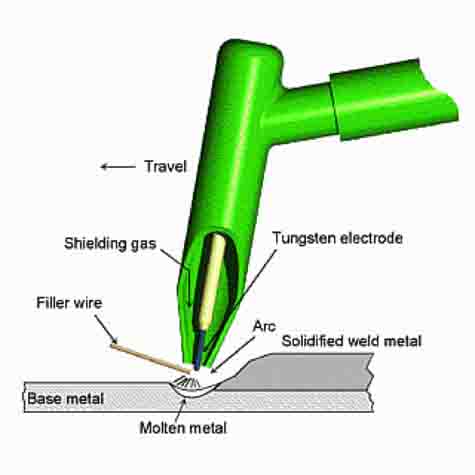
TIG welding torches have a duty-cycle rating as electrical devices.
Duty-cycle refers to the max. current the torch can withstand in 10 minutes.
Torches have several components:
- Electrical leads: that start at the welding machine and connect to the torch
- Collet: the part of the torch that holds the tungsten electrode
- Electrode cap
- Shielding gas nozzle: to control the gas stream. The nozzle size is dictated by the bead width and gas volume. Nozzle shape is designed to decrease turbulence. Some nozzle designs have the electrode sticking out 1 inch with no loss of gas or an increase in turbulence. Nozzles are made out of Pyrex glass, plastic, metal and ceramic. Ceramic is for welding projects up to 275 amps. Metal-coated or metal nozzles are for jobs over 300 amps. Plastic (high-temperature plastic) and Pyrex are transparent nozzles and are needed for some special welding applications.
- A hose: that carries the shielding gas
- Water coolant hose (unless a smaller torch cooled with air): water-cooled TIG welding machines have 3 hoses that extend to the torch.
- One carries shielding gas and is made of plastic to prevent chemical reactions that might cause contamination.
- One carries a combination of coolant and the electrode lead. The lead is a woven metal tube with good current-carrying capacity.
The tube is covered by rubber or plastic-insulating material. Current travels through the woven metal tube, and coolant passes through the middle of the tube. - The third hose carries the return coolant to the storage reservoir or to a drain.
Other types of TIG equipment torches such as smaller light-duty torches are air-cooled and usually have only one hose connected to them, which is a combination electrode lead and shielding gas hose.
The electrode lead may be either a woven tube or a flexible cable, and the shielding gas acts to cool the electrode lead as it flows to the torch.
TIG Electrodes
TIG welding electrodes come in the following variations:
- Pure tungsten: least expensive, but have less capacity for carrying current and can be easily contaminated. Not used for this reason with critical welds. Adding thoria or zirconia improves the conductivity of the tungsten…
- Pure tungsten with a core of 1 to 2% thoria: good current-carrying capacity, maintain shape longer, good resistance to becoming contaminated, arc is easier to strike
- Tungsten with 1 or 2% thoria: preferred for general purpose welding. Used when welding critical items such as airplanes, heat exchangers, nuclear reactors or missiles
- Tungsten with 0.15 to 0.40% zirconia: midpoint option with quality between pure tungsten and tungsten with thoria options.
Read more: TIG Tungsten Electrodes Explained
TIG welding tungsten electrodes also vary by finish:
- Clean finish: smooth surface, free from defects, good for most types of TIG (GTAW) welding jobs
- Centerless ground finish: mirror finish for jobs that require higher-quality welding.
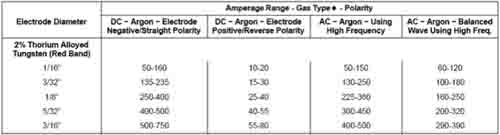
Other TIG equipment electrode selection criteria:
- Electrode diameter
- Amperage
- Type of current
- Type of shielding gas
- Whether the high frequency wave is balanced or unbalanced.
Before being used for TIG welding, electrodes must be sized and shaped.
Some TIG welding jobs call for an electrode with a specific shape, which are used for critical welds.
Electrodes that are contaminated or those which are too long to fit into the electrode cap must be shortened.
The desired shape of an electrode after it is properly broken is a square, blunt edge. Electrodes may be broken with pliers, wire cutters, or a hammer. The electrode end must be correctly shaped after it has been broken.
Most TIG welds need an electrode with a sharp point along with DCSP current. For AC (alternating current) a rounded (balled) electrode end is required.
To control any shielding gas, a flowmeter is used and calibrated in liters per minute (L/min.) or cu. ft. per hour (cfh) or both. For accurate readings, the flowmeter must be installed in a vertical position.
Tungsten Electrode Selection Diagram
TIG Welding Shielding Gases
There are differences between argon vs helium gas for TIG weld shielding.
Another approach is to use a combination of the two. All are described below.
Argon Gas
Argon gas provides more control and operates at lower heat levels, making it better for thinner metal welding.
- Cheaper than helium
- 1.4x heavier than air and 10x heavier than air, providing more arc weld control. Heavier gas can be a disadvantage if welding overhead.
- Lower arc voltage (when compared to helium) at any arc length and amperage. With lower voltage, there is less heat reducing the risk of burn through and metal distortion, which is why argon is better for thinner metals.
- Good arc stability
- arc cone is focused
- Good cleaning action
- Lower arc voltages
- 10-30 CFH flow rates
- Good arc starting
Also read: Argon Gas Tank Size Chart
Helium Gas
Used when thicker metal is being welded that requires higher arc voltages.
- Less low amp stability
- Increased penetration
- Less cleaning action
- Flared arc cone
- Higher arc voltages
- Higher flow rates (2x)
- Difficult arc starting
- Higher cost than argon
- Faster travel speeds
Argon and Helium Gas Mixture
- Advantages over Pure Argon
- Higher costs than using 100% argon
- Improved travel speeds
- Improved penetration
- Cleaning properties closer to pure argon
- Higher flow rates than pure argon
- Advantages over Pure Helium
- Improved arc starting
- Improved arc stability
- Arc cone shape more focused
- Produces Arc voltages between pure argon and pure helium