Home
 Instant  e Books  !
Books
DVD and Video
Buyers Guide
**********************
Arc Welding
Braze Cast Iron
Metal Casting
Metal Plating
Arc Equipment
Mig - GMAW
Tig - GTAW
SAW-Sub Arc
Oxy Fuel Welding
Aluminum Weld
Carbon Cutting
Cast Iron
Electrodes
Flux Core
Friction Weld
Ironwork
Laser Welding
Metal ID
Metal Art
OxyFuel Cutting
Plasma Cutting
Plasma Welding
Plastic Repair
Resistance Weld
Robotic Welding
Sheet Metal
 Terminology
Thermit Welding
troubleshooting
Underwater Welding
Welding Career
Braze Aluminum
Welding Projects
Weld Symbols
Weld Testing
Electrode Storage
Metal Fume Fever
Safety
110 volt Migs
Welding History
Grinder  Quiz
Safety Quiz
Weld Codes
Powder Coating
Paint a Car
Welding Superbook
rendezvous

Welding Safety, PPE, Cutting Safety


GENERAL Welding Safety, PPE, Cutting Safety PRECAUTIONS

a. To prevent injury to personnel, extreme caution should be exercised when using any types of welding equipment.

Injury can result from fire, explosions, electric shock, or harmful agents.

Both the general and specific safety precautions listed below must be strictly observed by workers who weld or cut metals.

b. Do not permit unauthorized persons to use welding or cutting equipment.

c. Do not weld in a building with wooden floors, unless the floors are protected from hot metal by means of fire resistant fabric, sand, or other fireproof material.

Be sure that hot sparks or hot metal will not fall on the operator or on any welding equipment components.

d. Remove all flammable material, such as cotton, oil, gasoline, etc., from the vicinity of welding.

e. Before welding or cutting, warm those in close proximity who are not protected to wear proper clothing or goggles.

f. Remove any assembled parts from the component being welded that may become warped or otherwise damaged by the welding process.

g. Do not leave hot rejected electrode stubs, steel scrap, or tools on the floor or around the welding equipment.

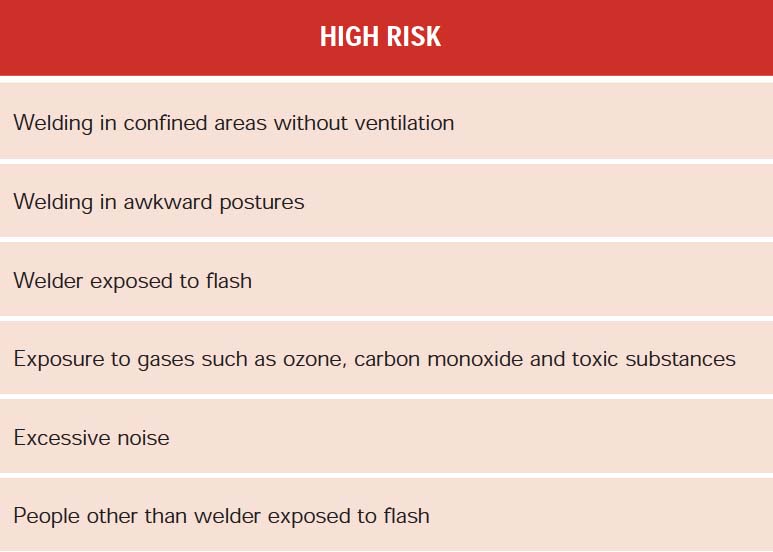
Welding Safety, PPE, Cutting Safety Accidents and/or fires may occur.

h. Keep a suitable fire extinguisher nearby at all times.

Ensure the fire extinguisher is in operable condition.

i. Mark all hot metal after welding operations are completed.

Soapstone is commonly used for this purpose.

PERSONAL PROTECTIVE EQUIPMENT


a. General.

The electric arc is a very powerful source of light, including visible, ultraviolet, and infrared.

Protective clothing and equipment must be worn during all welding operations.

During all oxyacetylene welding and cutting proccesses, operators must use safety goggles to protect the eyes from heat, glare, and flying fragments of hot metals.

During all electric welding processes, operators must use safety goggles and a hand shield or helmet equipped with a suitable filter glass to protect against the intense ultraviolet and infrared rays.

When others are in the vicinity of the electric welding processes, the area must be screened so the arc cannot be seen either directly or by reflection from glass or metal.

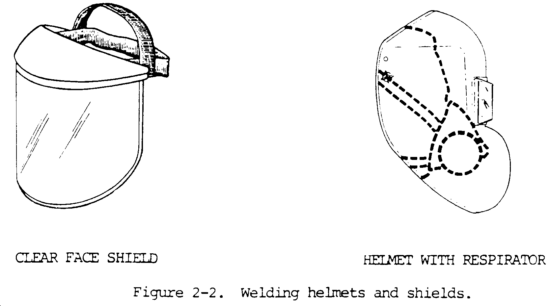
b. Helmets and Shields.

(1) Welding arcs are intensely brilliant lights.

They contain a proportion of ultraviolet light which may cause eye damage.

For this reason, the arc should never be viewed with the naked eye within a distance of 50.0 ft (15.2 m).

The brilliance and exact spectrum, and therefore the danger of the light, depends on the welding process, the metals in the arc, the arc atmosphere, the length of the arc, and the welding current.

Operators, fitters, and those working nearby need protection against arc radiation.

The intensity of the light from the arc increases with increasing current and arc voltage.

Arc radiation, like all light radiation, decreases with the square of the distance.

Those processes that produce smoke surrounding the arc have a less bright arc since the smoke acts as a filter.

The spectrum of the welding arc is similar to that of the sun. Exposure of the skin and eyes to the arc is the same as exposure to the sun.

(2) Being closest, the welder needs a helmet to protect his eyes and face from harmful light and particles of hot metal.
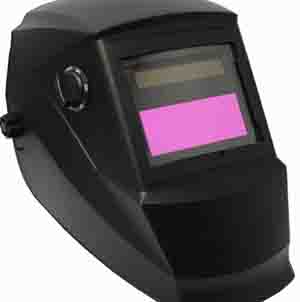
The welding helmet is generally constructed of a pressed fiber insulating material.

It has an adjustable headband that makes it usable by persons with different head sizes.

To minimize reflection and glare produced by the intense light, the helmet is dull black in color.

It fits over the head and can be swung upward when not welding. The chief advantage of the helmet is that it leaves both hands free, making it possible to hold the work and weld at the same time.

(3) The hand-held shield provides the same protection as the helmet, but is held in position by the handle.

This type of shield is frequently used by an observer or a person who welds for a short period of time.

(4) The protective welding helmet has lens holders used to insert the cover glass and the filter glass or plate.

Standard size for the filter plate is 2 x 4-1/4 in. (50 x 108 mm). In some helmets lens holders open or flip upwards.

Lenses are designed to prevent flash burns and eye damage by absorption of the infrared and ultraviolet rays produced by the arc.

The filter glasses or plates come in various optical densities to filter out various light intensities, depending on the welding process, type of base metal, and the welding current.

The color of the lens, usually green, blue, or brown, is an added protection against the intensity of white light or glare.

Colored lenses make it possible to clearly see the metal and weld. . A magnifier lens placed behind the filter glass is sometimes used to provide clear vision.

A cover plate should be placed outside the filter glass to protect it from weld spatter.

The filter glass must be tempered so that is will not break if hit by flying weld spatter.

Filter glasses must be marked showing the manufacturer, the shade number, and the letter “H’ indicating it has been treated for impact resistance.

(5) Gas metal-arc (MIG) welding requires darker filter lenses than shielded metal-arc (stick) welding.

The intensity of the ultraviolet radiation emitted during gas metal-arc welding ranges from 5 to 30 times brighter than welding with covered electrodes.

(6) Do not weld with cracked or defective shields because penetrating rays from the arc may cause serious burns.

Be sure that the colored glass plates are the proper shade for arc welding. Protect the colored glass plate from molten metal spatter by using a cover glass.

Replace the cover glass when damaged or spotted by molten metal spatter.

(7) Face shields must also be worn where required to protect eyes. Welders must wear safety glasses and chippers and grinders often use face shields in addition to safety glasses.

(8) In some welding operations, the use of mask-type respirators is required.

Helmets with the "bubble" front design can be adapted for use with respirators.

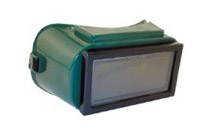
c. Safety Goggles.


During all electric welding processes, operators must wear safety goggles to protect their eyes from weld spatter which occasionally gets inside the helmet.

These clear goggles also protect the eyes from slag particles when chipping and hot sparks when grinding.

Contact lenses should not be worn when welding or working around welders.

Tinted safety glasses with side shields are recommended, especially when welders are chipping or grinding.

Those working around welders should also wear tinted safety glasses with side shields.

d. Protective Clothing.

(1) Personnel exposed to the hazards created by welding, cutting, or brazing operations shall be protected by personal protective equipment in accordance with OSHA standards, Subpart I, Personal Protective Equipment, paragraph 1910.132.

The appropriate protective clothing required for any welding operation will vary with the size, nature, and location of the work to be performed.

Welders should wear work or shop clothes without openings or gaps to prevent arc rays from contacting the skin.

Those working close to arc welding should also wear protective clothing. Clothing should always be kept dry, including gloves.

(2) Woolen clothing should be worn instead of cotton since wool is not easily burned or damaged by weld spatter and helps to protect the welder from changes in temperature.

Cotton clothing, if used, should be chemically treated to reduce its combustibility.

All other clothing, such as jumpers or overalls, should be reasonably free from oil or grease.

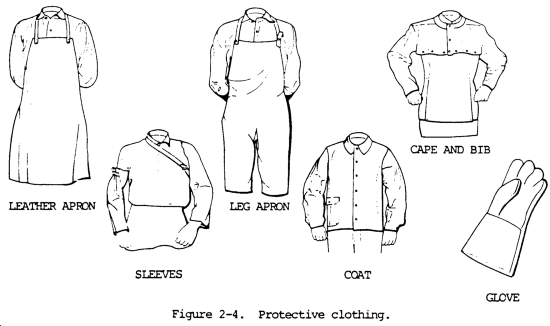
(3) Flameproof aprons or jackets made of leather, fire resistant material, or other suitable material should be worn for protection against spatter of molten metal, radiated heat, and sparks.

Capes or shoulder covers made of leather or other suitable materials should be worn during overhead welding or cutting operations.

Leather skull caps may be worn under helmets to prevent head burns.

(4) Sparks may lodge in rolled-up sleeves, pockets of clothing, or cuffs of overalls and trousers.

Therefore, sleeves and collars should be kept buttoned and pockets should be eliminated from the front of overalls and aprons.

Trousers and overalls should not be turned up on the outside. For heavy work, fire-resisant leggings, high boots, or other equivalent means should be used.

In production work, a sheet metal screen in front of the worker´s legs can provide further protection against sparks and molten metal in cutting operations.


(5) Flameproof gauntlet gloves, preferably of leather, should be worn to protect the hands and arms from rays of the arc, molten metal spatter, sparks, and hot metal.

Leather gloves should be of sufficient thickness so that they will not shrivel from the heat, burn through, or wear out quickly.

Leather gloves should not be used to pick up hot items, since this causes the leather to become stiff and crack.

Do not allow oil or grease to cane in contact with the gloves as this will reduce their flame resistance and cause them to be readily ignited or charred.

e. Protective Equipment.


(1) Where there is exposure to sharp or heavy falling objects or a hazard of bumping in confined spaces, hard hats or head protectors must be used.

(2) For welding and cutting overhead or in confined spaces, steel-toed boots and ear protection must also be used.

(3) When welding in any area, the operation should be adequately screened to protect nearby workers or passers-by froman the glare of welding.

The screens should be arranged so that no serious restriction of ventilation exists. The screens should be mounted so that they are about 2.0 ft above the floor unless the work is performed at such a low level that the screen must be extended closer to the floor to protect adjacent workers.

The height of the screen is normally 6.0 ft (1.8 m) but may be higher depending upon the situation.

Screen and surrounding areas must be painted with special paints which absorb ultraviolet radiation yet do not create high contrast between the bright and dark areas.

Light pastel colors of a zinc or titanium dioxide base paint are recommended. Black paint should not be used.

2-3. FIRE HAZARDS

a. Fire prevention and protection is the responsibility of welders, cutters, and supervisors.

Approximately six percent of the fires in industrial plants are caused by cutting and welding which has been done primarily with portable equipment or in areas not specifically designated for such work.

The elaboration of basic precautions to be taken for fire prevention during welding or cutting is found in the Standard for Fire Prevention in Use of Cutting and Welding Processes, National Fire Protection Association Standard 51B, 1962.

Some of the basic precautions for fire prevention in welding or cutting work are given below.

b. During the welding and cutting operations, sparks and molten spatter are formal which sometimes fly considerable distances.

Sparks have also fallen through cracks, pipe holes, or other small openings in floors and partitions, starting fires in other areas which temporarily may go unnoticed.

For these reasons, welding or cutting should not be done near flammable materials unless every precaution is taken to prevent ignition.

c. Hot pieces of base metal may come in contact with combustible materials and start fires.

Fires and explosions have also been caused when heat is transmitted through walls of containers to flammable atmospheres or to combustibles within containers.

Anything that is combustible or flammable is susceptible to ignition by cutting and welding.

d. When welding or cutting parts of vehicles, the oil pan, gasoline tank, and other parts of the vehicle are considered fire hazards and must be removed or effectively shielded from sparks, slag, and molten metal.

e. Whenever possible, flammable materials attached to or near equipment requiring welding, brazing, or cutting will be removed. If removal is not practical, a suitable shield of heat resistant material should be used to protect the flammable material.

Fire extinguishing equipment, for any type of fire that may be encountered, must be present.

2-4. HEALTH PROTECTION AND VENTILATION

a. General.

(1) All welding and thermal cutting operations carried on in confined spaces must be adequately ventilated to prevent the accumulation of toxic materials, combustible gases, or possible oxygen deficiency.

Monitoring instruments should be used to detect harmful atmospheres. Where it is impossible to provide adequate ventilation, air-supplied respirators or hose masks approved for this purpose must be used.

In these situations, lookouts must be used on the outside of the confined space to ensure the safety of those working within.

Requirements in this section have been established for arc and gas welding and cutting.

These requirements will govern the amount of contamination to which welders may be exposed:

(a) Dimensions of the area in which the welding process takes place (with special regard to height of ceiling).

(b) Number of welders in the room.

(c) Possible development of hazardous fumes, gases, or dust according to the metals involved.

(d) Location of welder's breathing zone with respect to rising plume of fumes.

(2) In specific cases, there are other factors involved in which respirator protective devices (ventilation) should be provided to meet the equivalent requirements of this section. They include:

(a) Atomspheric conditions.

(b) Generated heat.

(c) Presence of volatile solvents.

(3) In all cases, the required health protection, ventilation standards, and standard operating procedures for new as well as old welding operations should be coordinated and cleaned through the safety inspector and the industrial hygienist having responsibility for the safety and health aspects of the work area.

b. Screened Areas.

When welding must be performed in a space entirely screened on all sides, the screens shall be arranged so that no serious restriction of ventilation exists.

It is desirable to have the screens mounted so that they are about 2.0 ft (0.6 m) above the floor, unless the work is performed at such a low level that the screen must be extended closer to the floor to protect workers from the glare of welding. See paragraph 2-2 e (3).

c. Concentration of Toxic Substances.

Local exhaust or general ventilating systems shall be provided and arranged to keep the amount of toxic frees, gas, or dusts below the acceptable concentrations as set by the American National Standard Institute Standard 7.37; the latest Threshold Limit Values (TLV) of the American Conference of Governmental Industrial Hygienists; or the exposure limits as established by Public Law 91-596, Occupational Safety and Health Act of 1970.

Compliance shall be determined by sampling of the atmsphere. Samples collected shall reflect the exposure of the persons involved. When a helmet is worn, the samples shall be collected under the helmet.

d. Respiratory Protective Equipment.

Individual respiratory protective equipment will be well retained. Only respiratory protective equipment approved by the US Bureau of Mines, National Institute of Occupational Safety and Health, or other government-approved testing agency shall be utilized. Guidance for selection, care, and maintenance of respiratory protective equipment is given in Practices for Respiratory Protection, American National Standard Institute Standard 788.2 and TB MED 223. Respiratory protective equipment will not be transferred from one individual to another without being disinfected.

e. Precautionary Labels.

A number of potentially hazardous materials are used in flux coatings, coverings, and filler metals.

These materials, when used in welding and cutting operations, will become hazardous to the welder as they are released into the atmosphere.

These include, but are not limited to, the following materials: fluorine compounds, zinc, lead, beryllium, cadmium, and mercury.

See paragraph 2-4 i through 2-4 n. The suppliers of welding materials shall determine the hazard, if any, associated with the use of their materials in welding, cutting, etc.

(1) All filler metals and fusible granular materials shall carry the following notice, as a minimum, on tags, boxes, or other containers:

CAUTION

Welding may produce fumes and gases hazardous to health.

Avoid breathing these fumes and gases.

Use adequate ventilation. See American National Standards Institute Standard Z49.1-1973, Safety in Welding and Cutting published by the American Welding Society.

(2) Brazing (welding) filler metals containing cadmium in significant amounts shall carry the following notice on tags, boxes, or other containers:

WARNING
CONTAINS CADMIUM - POISONOUS FUMES MAY BE FORMED ON HEATING

Do not breathe fumes.

Use only with adequate ventilation, such as fume collectors, exhaust ventilators, or air-supplied respirators.

See American National Standards Institute Standard Z49.1-1973. If chest pain, cough, or fever develops after use, call physician immediately.

g. Local Exhaust Ventilation. Mechanical local exhaust ventilation may be obtained by either of the following means:

(1) Hoods.

Freely movable hoods or ducts are intended to be placed by the welder as near as practicable to the work being welded.

These will provide a rate of airflow sufficient to maintain a velocity the direction of the hood of 100 in linear feet per minute in the zone of welding.

(2) Fixed enclosure.

A fixed enclosure with a top and two or more sides which surrounds the welding or cutting operations will have a rate of airflow sufficient to maintain a velocity away from the welder of not less than 100 linear ft per minute.

Downdraft ventilation tables require 150 cu ft per minute per square foot of surface area.

This rate of exhausted air shall be uniform across the face of the grille.

A low volume, high-density fume exhaust device attached to the welding gun collects the fumes as close as possible to the point of origin or at the arc.

This method of fume exhaust has become quite popular for the semiautomatic processes, particularly the flux-cored arc welding process.

Smoke exhaust systems incorporated in semiautomatic guns provide the most economical exhaust system since they exhaust much less air they eliminate the need for massive air makeup units to provide heated or cooled air to replace the air exhausted.

Local ventilation should have a rate of air flow sufficient to maintain a velocity away from the welder of not less than 100 ft (30 m) per minute.

Air velocity is measurable using a velometer or air flow inter. These two systems can be extremely difficult to use when welding other than small weldments.

The down draft welding work tables are popular in Europe but are used to a limited degree North America.

In all cases when local ventilation is used, the exhaust air should be filtered.

h. Ventilation in Confined Spaces.

(1) Air replacement.

Ventilation is a perquisite to work in confined spaces.

All welding and cutting operations in confined spaces shall be adequately ventilated to prevent the accumulation of toxic materials -or possible oxygen deficiency.

This applies not only to the welder but also to helpers and other personnel in the immediate vicinity.

(2) Airline respirators.

In circumstances where it is impossible to provide adequate ventilation in a confined area, airline respirators or hose masks, approved by the US Bureau of Mines, National Institute of Occupational Safety and Health, or other government-approved testing agency, will be used for this purpose.

The air should meet the standards established by Public Law 91-596, Occupational Safety and Health Act of 1970.

(3) Self-contained units.

In areas immediately hazardous to life, hose masks with blowers or self-contained breathing equipment shall be used.

The breathing equipment shall be approved by the US Bureau of Mines or National Institute of Occupational Safety and Health, or other government-approved testing agency.

(4) Outside helper.

Where welding operations are carried on in confined spaces and where welders and helpers are provided with hose masks, hose masks with blowers, or self-contained breathing equipment, a worker shall be stationed on the outside of such confined spaces to ensure the safety of those working within.

(5) Oxygen for ventilation.

Oxygen must never be used for ventilation.

i. Fluorine Compounds.

(1) General.

In confined spaces, welding or cutting involving fluxes, coverings, or other materials which fluorine compounds shall be done in accordance with paragraph 2-4 h, ventilation in confined spaces.

A fluorine compound is one that contains fluorine as an element in chemical combination, not as a free gas.

(2) Maximum allowable concentration.

The need for local exhaust ventilation or airline respirators for welding or cutting in other than confined spaces will depend upon the individual circumstances.

However, experience has shown that such protection is desirable for fixed-location production welding and for all production welding on stainless steels.

When air samples taken at the welding location indicate that the fluorides liberated are below the maximum allowable concentration, such protection is not necessary.

j. Zinc.

(1) Confined spaces.

In confined spaces, welding or cutting involving zinc-bearing filler metals or metals coated with zinc-bearing materials shall be done in accordance with paragraph 2-4 h, ventilation in confined spaces.

(2) Indoors.

Indoors, welding or cutting involving zinc-bearing metals or filler metals coated with zinc-bearing materials shall be done in accordance with paragraph 2-4 g.

k. Lead.

(1) Confined spaces.

In confined spaces, welding involving lead-base metals (erroneously called lead-burning) shall be done in accordance with paragraph 2-4 h.

(2) Indoors.

Indoors, welding involving lead-base metals shall be done in accordance with paragraph 2-4 g, local exhaust ventilation.

(3) Local ventilation.

In confined spaces or indoors, welding or cutting involving metals containing lead or metals coated with lead-bearing materials, including paint, shall be done using local exhaust ventilation or airline respirators.

Outdoors, such operations shall be done using respirator protective equipment approved by the US Bureau of Mines, National Institute of Occupational Safety and Health, or other government-approved testing agency.

In all cases, workers in the immediate vicinity of the cutting or welding operation shall be protected as necessary by local exhaust ventilation or airline respirators.

l. Beryllium.

Welding or cutting indoors, outdoors, or in confined spaces involving beryllium-bearing material or filler metals will be done using local exhaust ventilation and airline respirators.

This must be performed without excep-tion unless atmospheric tests under the most adverse conditions have established that the workers´ exposure is within the acceptable concentrations of the latest Threshold Limit Values (TLV) of the American Conference of Governmental Industrial Hygienists, or the exposure limits established by Public Law 91-596, Occupational Safety and Health Act of 1970.

In all cases, workers in the immediate vicinity of the welding or cutting operations shall be protected as necessary by local exhaust ventilation or airline respirators.

m. Cadmium.

(1) General.

Welding or cutting indoors or in confined spaces involving cadmium-bearing or cadmium-coated base metals will be done using local exhaust ventilation or airline respirators.

Outdoors, such operations shall be done using respiratory protective equipment such as fume respirators, approved by the US Bureau of Mines, National Institute of Occupational Safety and Health, or other government-approved testing agency, for such purposes.

(2) Confined space.

Welding (brazing) involving cadmium-bearing filler metals shall be done using ventilation as prescribed in paragraphs 2-4 g, local exhaust ventilation, and 2-4 h, ventilation in confined spaces, if the work is to be done in a confined space.

NOTE

Cadmium-free rods are available and can be used in most instances with satisfactory results.

n. Mercury.

Welding or cutting indoors or in a confined space involving metals coated with mercury-bearing materials, including paint, shall be done using local exhaust ventilation or airline respirators. Outdoors, such operations will be done using respiratory protective equipment approved by the National Institute of Occupational Safety and Health, US Bureau of Mines, or other government-approved testing agency.

o. Cleaning Compounds.

(1) Manufacturer´s instructions.

In the use of cleaning materials, because of their toxicity of flammability, appropriate precautions listed in the manufacturer´s instructions will be followed.

(2) Degreasing.

Degreasing or other cleaning operations involving chlorinated hydrocarbons will be located so that no vapors from these operations will reach or be drawn into the area surrounding any welding operation. In addition, trichloroethylene and perchloroethylene should be kept out of atmospheres penetrated by the ultraviolet radiation of gas-shielded welding operations.

p. Cutting of Stainless Steels.

Oxygen cutting, using either a chemical flux or iron powder, or gas-shielded arc cutting of stainless steel will be done using mechanical ventilation adequate to remove the fumes generated.

q. First-Aid Equipment.

First-aid equipment will be available at all times. On every shift of welding operations, there will be personnel present who are trained to render first-aid.

All injuries will be reported as soon as possible for medical attention. First-aid will be rendered until medical attention can be provided.

2-5. WELDING IN CONFINED SPACES

a. A confined space is intended to mean a relatively small or restricted space such as a tank, boiler, pressure vessel, or small compartment of a ship or tank.

b. When welding or cutting is being performed in any confined space, the gas cylinders and welding machines shall be left on the outside. Before operations are started, heavy portable equipment mounted on wheels shall be securely blocked to prevent accidental movement.

c. Where a welder must enter a confined space through a manhole or other all opening, means will be provided for quickly removing him in case of emergency. When safety belts and life lines are used for this purpose, they will be attached to the welder´s body so that he cannot be jammed in a small exit opening.

An attendant with a preplanned rescue procedure will be stationed outside to observe the welder at all times and be capable of putting rescue operations into effect.

d. When arc welding is suspended for any substantial period of time, such as during lunch or overnight, all electrodes will be removed from the holders with the holders carefully located so that accidental contact cannot occur.

The welding machines will be disconnected from the power source.

e. In order to eliminate the possibility of gas escaping through leaks or improperly closed valves when gas welding or cutting, the gas and oxygen supply valves will be closed, the regulators released, the gas and oxygen lines bled, and the valves on the torch shut off when the equipment will not be used for a substantial period of time.

Where practical, the torch and hose will also be removed from the confined space.

f. After welding operations are completed, the welder will mark the hot metal or provide some other means of warning other workers.

Section III. SAFETY IN ARC WELDING AND CUTTING

2-12. ELECTRIC CIRCUITS

a. A shock hazard is associated with all electrical equipment, including extension lights, electric hand tools, and all types of electrically powered machinery.

Ordinary household voltage (115 V) is higher than the output voltage of a conventional arc welding machine.

b. Although the ac and dc open circuit voltages are low compared to voltages used for lighting circuits and motor driven shop tools, these voltages can cause severe shock, particularly in hot weather when the welder is sweating.

Consequently, the precautions listed below should always be observed.

(1) Check the welding equipment to make certain that electrode connections and insulation on holders and cables are in good condition.

(2) Keep hands and body insulated from both the work and the metal electrode holder. Avoid standing on wet floors or coming in contact with grounded surfaces.

(3) Perform all welding operations within the rated capacity of the welding cables.

Excessive heating will impair the insulation and damage the cable leads.

c. Inspect the cables periodically for looseness at the joints, defects due to wear, or other damage.

Defective or loose cables are a fire hazard. Defective electrode holders should be replaced and connections to the holder should be tightened.

d. Welding generators should be located or shielded so that dust, water, or other foreign matter will not enter the electrical windings or the bearings.

e. Disconnect switches should be used with all power sources so that they can be disconnected from the main lines for maintenance.

2-13. WELDING MACHINES

a. When electric generators powered by internal combustion engines are used inside buildings or in confined areas, the engine exhaust must be conducted to the outside atmosphere.

b. Check the welding equipment to make sur the electrode connections and the insulation on holders and cables are in good condition.

All checking should be done with the machine off or unplugged. All serious trouble should be investigated by a trained electrician.

c. Motor-generator welding machines feature complete separation of the primary power and the welding circuit since the generator is mechanically connected to the electric rotor.

A rotor-generator type arc welding machine must have a power ground on the machine.

Metal frames and cases of motor generators must be grounded since the high voltage from the main line does come into the case.

Stray current may cause a severe shock to the operator if he should contact the machine and a good ground.

d. In transformer and rectifier type welding machines, the metal frame and cases must be grounded to the earth.

The work terminal of the welding machine should not be grounded to the earth.

e. Phases of a three-phase power line must be accurately identified when paralleling transformer welding machines to ensure that the machines are on the same phase and in phase with one another.

To check, connect the work leads together and measure the voltage between the electrode holders of the two machines.

This voltage should be practically zero. If it is double the normal open circuit voltage, it means that either the primary or secondary connections are reversed.

If the voltage is approximately 1-1/2 times the normal open circuit voltage it means that the machines are connected to different phases of the three phase power line. Corrections must be made before welding begins.

f. When large weldments, like ships, buildings, or structural parts are involved, it is normal to have the work terminal of many welding machines connected to it.

It is important that the machines be connected to the proper phase and have the same polarity.

Check by measuring the voltage between the electrode holders of the different machines as mentioned above.

The situation can also occur with respect to direct current power sources when they are connected to a common weldment.

If one machine is connected for straight polarity and one for reverse polarity, the voltage between the electrode holders will be double the normal open circuit voltage.

Precautions should be taken to see that all machines are of the same polarity when connected to a common weldment.

g. Do not operate the polarity switch while the machine is operating under welding current load.

Consequent arcing at the switch will damage the contact surfaces and the flash may burn the person operating the switch.

h. Do not operate the rotary switch for current settings while the machine is operating under welding current load.

Severe burning of the switch contact surfaces will result. Operate the rotary switch while the machine is idling.

i. Disconnect the welding machines from the power supply when they are left unattended.

j. The welding electrode holders must be connected to machines with flexible cables for welding application.

Use only insulated electrode holders and cables. There can be no splices in the electrode cable within 10 feet (3 meters) of the electrode holder.

Splices, if used in work or electrode leads, must be insulated. Wear dry protective covering on hands and body.

k. Partially used electrodes should be removed from the holders when not in use.

A place will be provided to hang up or lay down the holder where it will not come in contact with persons or conducting objects.

l. The work clamp must be securely attached to the work before the start of the welding operation.

m. Locate welding machines where they have adequate ventilation and ventilation ports are not obstructed.

2-14. PROTECTIVE SCREENS

a. When welding is done near other personnel, screens should be used to protect their eyes from the arc or reflected glare.

b. In addition to using portable screens to protect other personnel, screens should be used, when necessary, to prevent drafts of air from interfering with the stability of the arc.

c. Arc welding operations give off an intense light. Snap-on light-proof screens should be used to cover the windows of the welding truck to avoid detection when welding at night.

SAFETY PRECAUTIONS FOR WELDING AND CUTTING CONTAINERS THAT HAVE HELD COMBUSTIBLES

EXPLOSION HAZARDS
a. Severe explosions and fires can result from heating, welding, and cutting containers which are not free of combustible solids, liquids, vapors, dusts, and gases.

Containers of this kind can be made safe by following one of the methods described in paragraphs 2-22 through 2-26. Cleaning the container is necessary in all cases before welding or cutting.

WARNING

Do not assume that a container that has held combustibles is clean and safe until proven so by proper tests.

Do not weld in places where dust or other combustible particles are suspended in air or where explosive vapors are present.

Removal of flammable material from vessels and/or containers may be done either by steaming out or boiling.

b. Flammable and explosive substances may be present in a container because it previously held one of the following substances:

(1) Gasoline, light oil, or other volatile liquid that releases potentially hazardous vapors at atomspheric pressure.

(2) An acid that reacts with metals to produce hydrogen.

(3) A nonvolatile oil or a solid that will not release hazardous vapors at ordinary temperatures, but will release such vapors when exposed to heat.

(4) A combustible solid; i. e., finely divided particles which may be present in the form of an explosive dust cloud.

c. Any container of hollow body such as a can, tank, hollow compartment in a welding, or a hollow area on a casting, should be given special attention prior to welding.

Even though it may contain only air, heat from welding the metal can raise the temperature of the enclosed air or gas to a dangerously high pressure, causing the container to explode.

Hollow areas can also contain oxygen-enriched air or fuel gases, which can be hazardous when heated exposed to an arc or or flame. Cleaning the container is necessary in all cases before cutting or welding.

History

SMAW History

Equipment

SMAW Equipment

Terms and Joints

SMAW Term and Joints

Operation

SMAW Operation

footer for Welding Safety page